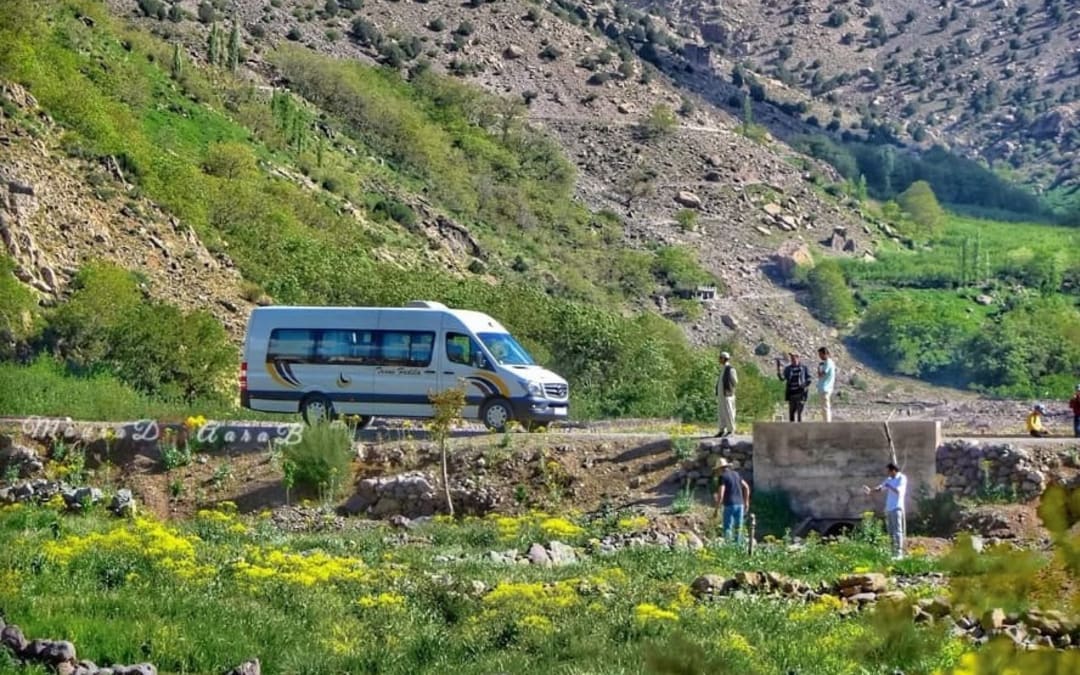

Toubkal, at 4,167 m the highest peak in North Africa, is climbed in two days from the village of Imlil, 1.5 hours from Marrakech. You do not need to be a mountaineer: outside winter, it is a long high-altitude hike with no technical sections. You do, however, need to be fit, go with a licensed mountain guide (it is compulsory) and pick the right season. Here is the practical side, just as we explain it to the hikers we drive to Imlil every week.
The key figures
- Start: Imlil, 1,740 m above sea level.
- Overnight: at the refuge, around 3,200 m.
- Summit: 4,167 m.
- Height gain: about 1,500 m of ascent on day one; nearly 1,000 m up and then 2,400 m down on day two.
- Walking time: 5 to 6 hours on day one, 8 to 10 hours on day two.
That last figure often surprises people. Day two is very long, and it is the descent, more than the climb, that wears out your knees.
How the climb usually goes
Day 1: Imlil to the refuge
You set off in the late morning, after the transfer from Marrakech and meeting your guide. The trail passes through the village of Aremd, crosses a wide riverbed, then climbs the valley to the shrine of Sidi Chamharouch, where you take a break among the small drinks stalls. From there it climbs steadily, with nothing technical, up to the refuge.
Mules carry the big bags; you only keep a day pack with water, a warm layer and snacks. Dinner is early and so is bedtime: the night is short.
Day 2: summit, then the descent
You get up between 4 and 5 am. You climb by headtorch up a scree gully, often in cold and wind. The summit takes three to four hours. On a clear day the view stretches across the whole High Atlas and, to the south, as far as the Anti-Atlas ranges. You go back to the refuge to refuel, then make the long descent to Imlil, where your driver can meet you in the late afternoon to take you back to Marrakech.
A guide is compulsory
Since 2019, Toubkal must be climbed with a licensed mountain guide. There are checks on the trail where you may be asked for your passport, so keep it with you. Beyond the rule, it is simply sensible. A guide knows the terrain, sets the pace for the altitude, handles the refuge and the mules, and knows when to turn back.
You can book a guide through the guesthouses in Imlil or through a specialist trekking agency. We take care of the transport: the Marrakech to Imlil private transfer on the way out, and the return at a time that suits you, with no need to haggle for a grand taxi from Asni.
Which season?
| Period | Conditions | Suitable for |
|---|---|---|
| May and June | Some snow up high early in the season, pleasant temperatures | Fit hikers |
| July and August | Hot in the valley, cold on the summit at dawn, possible afternoon storms | Fit hikers |
| September and October | Settled, clear weather, cool nights | The best time, along with spring |
| November to April | Snow and ice: crampons, ice axe, winter experience | Experienced mountaineers only |
In winter Toubkal becomes a proper mountain climb: every year, poorly equipped hikers get hurt. Do not let anyone convince you to go in trainers because “the path is easy”; it is in September, not in February.
Altitude
Above 3,000 m, many people get headaches, lose their appetite or sleep badly at the refuge. This is common and usually harmless, as long as you climb slowly and drink plenty. If symptoms get worse (vomiting, extreme tiredness, confusion), you go down: that is the only real cure. A night in Imlil beforehand helps you acclimatise and makes day one less rushed.
How fit do you need to be?
You need to be able to walk eight to ten hours in a day, on rocky ground, with plenty of ascent and descent. If you hike regularly in the mountains, you will be fine. If your main exercise is walking around town, train for a few weeks beforehand: stairs, hikes with a pack and, above all, downhill walking. People who turn back before the summit rarely do so because they are out of breath; it is more often painful knees or a bad night’s sleep.
What to pack
- Broken-in hiking boots with ankle support.
- A warm jacket, a windproof layer, a hat and gloves, even in summer.
- A headtorch for the early start.
- Two litres of water, plus purification tablets or a filter bottle.
- Sun cream, sunglasses and a hat.
- Walking poles, invaluable on the way down.
- A light sleeping bag or a liner, depending on the refuge.
- Cash in dirhams for the refuge, drinks and tips for the team.
Not ready for the summit?
Toubkal is not the only way to experience the High Atlas. Our Imlil and High Atlas valleys day trip includes a hike of a few hours towards Aremd, with views of the massif and a Berber lunch, in one day from Marrakech. Our Imlil hiking guide covers the other possible loops, from the easiest to the most demanding.
In short
- Two days from Imlil, with a night at the refuge around 3,200 m.
- A licensed guide is compulsory; carry your passport.
- May-June and September-October; winter is for equipped mountaineers only.
- Day two lasts 8 to 10 hours: train for the descent as well.