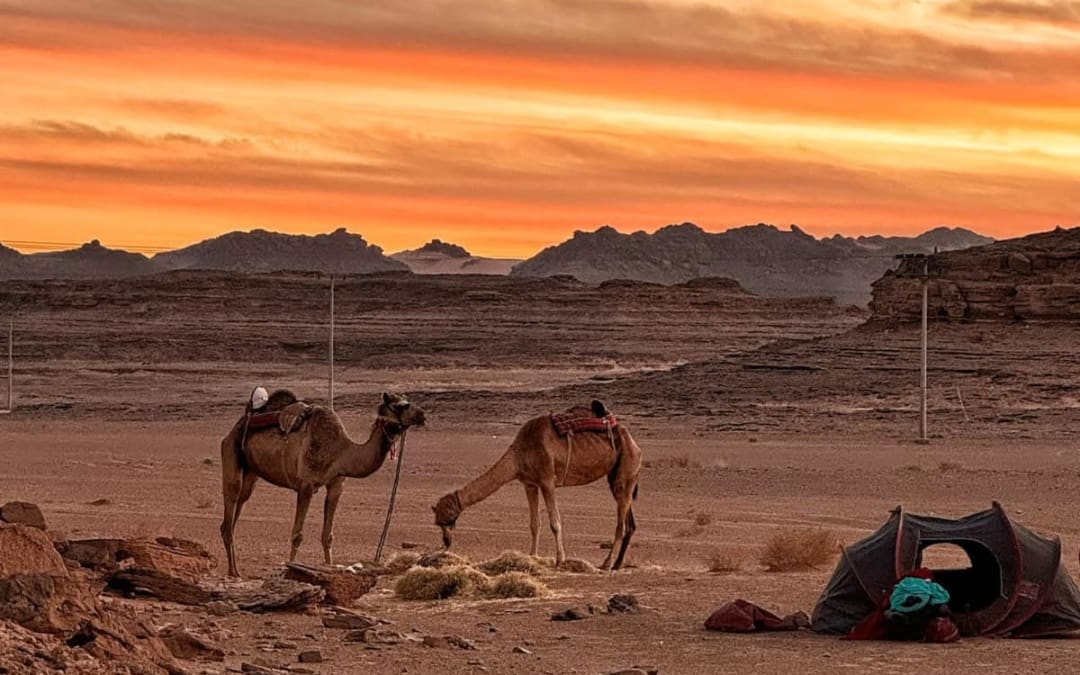
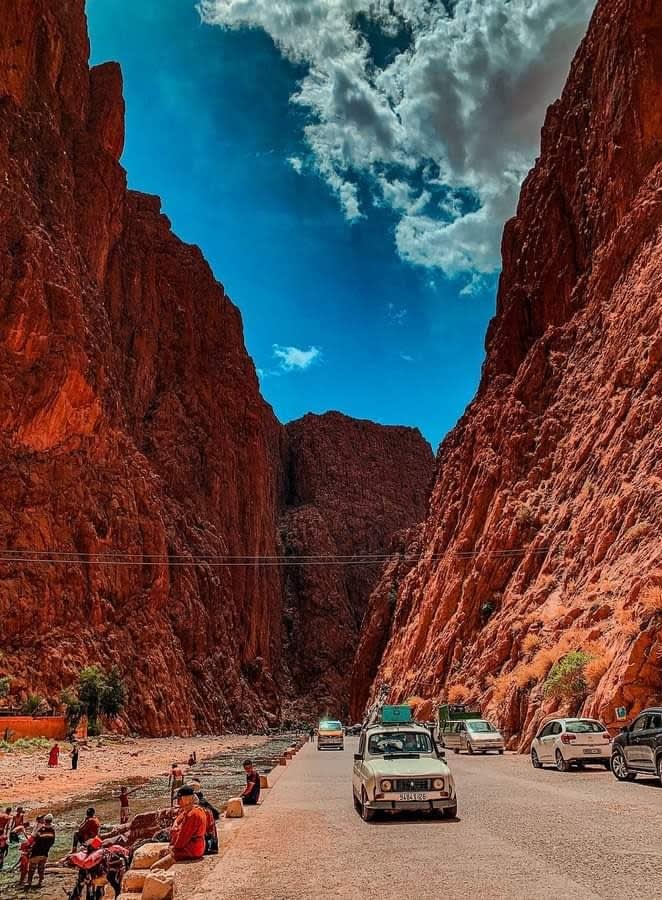
The Dades and Todra gorges are the two great canyons on the road between Marrakech and the Sahara, about an hour’s drive apart. The Dades is a green valley with a spectacular switchback road; the Todra is a narrow corridor between cliffs of around 300 metres that you explore on foot. On a three-day tour to Merzouga you usually sleep in the Dades valley and visit the Todra the next morning. Here is what you actually see, how much time to allow and which stops are worth it.
Dades and Todra: what is the difference?
| Dades Gorge | Todra Gorge | |
|---|---|---|
| Nearest town | Boumalne Dades | Tinghir |
| Landscape | Green valley, kasbahs, sculpted rocks | Narrow canyon, vertical cliffs |
| What you do | Scenic drive, photo stops, overnight stay | Walk through the gorge |
| Best time | Late afternoon | Early morning, before the groups |
| Time needed | 1.5 to 2 hours with stops | 1 to 1.5 hours |
You might think they are two versions of the same thing. They are not: you look at the Dades from the road, and you discover the Todra on foot.
The Dades valley
Coming from Ouarzazate, you first follow the Valley of Roses around Kelaat M’Gouna, where Damask roses are grown; in May, the harvest and the rose festival bring the whole area to life. At Boumalne Dades, a side road climbs the valley northwards, between poplars, terraced fields and mud-brick villages.
The stops we recommend:
- The “monkey fingers”, rounded, folded rock formations that look like knuckles; a short path lets you see them up close.
- The ruined kasbahs along the river, among the fields. Some can be visited, others are best photographed from the road.
- The Tisdrine switchbacks, the most photographed section: a road that coils in tight bends against the rock face. The view from the café above the bends is the photo almost everyone takes home.
Sleeping in the Dades has a real advantage: the late light on the red rocks, then a quiet evening at a hotel by the river. Our 3-day Merzouga desert tour spends its first night here for exactly that reason.
The Todra Gorge
After Tinghir and its large palm grove, the road heads into the canyon. For a few hundred metres the walls close in to about ten metres apart and rise to nearly 300 metres. A clear stream runs along the bottom; you walk on the flat road and the pebbles.
What to know:
- Come early. Around 10 or 11 am the minibuses arrive and the stallholders set up. At 8.30 am the gorge is almost empty and the light slowly slides down the cliff.
- Bring a warm layer: the sun only reaches the bottom for a few hours a day, so it is cool even in spring.
- Look up: the Todra is a well-known climbing spot, and you will often see climbers on the walls.
- A longer walk is possible further up the canyon beyond the narrows, or in the Tinghir palm grove, with a local guide.
On our tour, a local guide accompanies the visit and can also take you into the palm grove if time allows.
How much time do you really need?
The gorges alone do not justify a return trip from Marrakech: that would mean six to seven hours of driving each way. They make sense as a stop on the road to the desert. Our advice:
- On a 3-day tour, one night in the Dades and an early visit to the Todra are enough.
- With 4 days, add half a day of walking in the Dades or around Tinghir; the pace becomes much more pleasant.
- If you are going to Merzouga by private transfer, ask for an hour’s stop at the Todra: the entrance to the gorge is about fifteen kilometres off the main road.
For the whole journey, our article on the 3-day Merzouga tour itinerary covers each stage in detail, and the Marrakech to Merzouga private transfer lets you set your own pace, with the stops you choose.
When to go
Spring (March to May) and autumn (late September to November) are the best seasons. In summer the bottom of the gorges stays bearable thanks to the shade, but the drive there is scorching. In winter, nights in the Dades valley are cold, around 0°C, and it can snow on the higher ground: hotels are heated, some better than others.
After heavy rain, which is rare but sometimes violent, the river can cut the road for a few hours. Your driver checks before setting off and changes the order of the visits if needed.
A few practical tips
- Shoes: trainers are fine for the Todra; be ready to get them wet if you cross the stream.
- Cash: for the café at the switchbacks, parking, a tea or a rug bought along the way. Cash machines are in Boumalne and Tinghir.
- Stallholders in the Todra are persistent without being aggressive; a smiling “no thank you” is enough.
- Photos: late afternoon in the Dades; morning in the Todra, when the sun lights just one wall.
In short
- You see the Dades from the car and the Todra on foot.
- Sleep in the Dades, visit the Todra early the next day.
- Allow 1.5 to 2 hours for each, stops included.
- A stop on the road to Merzouga, not a return trip from Marrakech.