
Marrakech gave its name to the whole of Morocco, and its walls tell almost a thousand years of history: nomads from the Sahara who founded an empire, Almohad builders who raised one of the world’s most beautiful minarets, gold-laden Saadian sultans, palaces stripped bare then rediscovered. Rather than a list of dates, here is the city’s story told through ten monuments you can visit, in chronological order, with a walking route to link them.
Key dates: the great dynasties of Marrakech
| Period | Dynasty | What it left in Marrakech |
|---|---|---|
| About 1070 – 1147 | Almoravids | The founding, the Koubba, the ramparts, the khettaras |
| 1147 – 13th century | Almohads | The Koutoubia, Bab Agnaou, the Kasbah Mosque, the Menara |
| 13th – 15th century | Marinids | The first madrasa; the capital moves to Fes |
| 16th – 17th century | Saadians | El Badi Palace, the Saadian Tombs, the rebuilt madrasa, the Mellah |
| Since the 17th century | Alaouites | Bahia Palace, Dar Si Said, the modern city |
1. The founding: a camp at the foot of the Atlas (about 1070)
Around 1070, the Almoravids, Sanhaja Berber tribes from the Sahara, set up camp in the Haouz plain at the foot of the Atlas. Youssef ibn Tashfin made it the capital of an empire that would stretch as far as al-Andalus. According to the most common explanation, the city’s name comes from the Amazigh *amur n akuch*, “the land of God”. It passed into European languages as the name of the whole country: Maroc, Morocco, Marruecos.
2. The Almoravid Koubba (early 12th century)
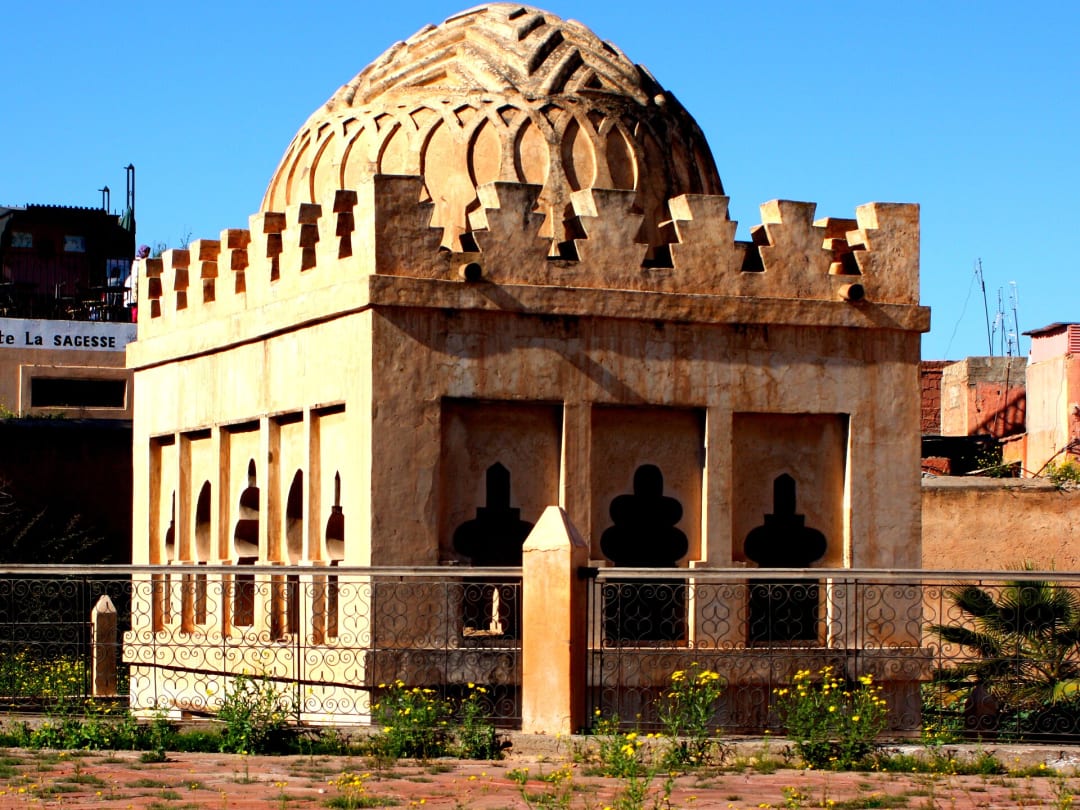
A small ablution pavilion with a carved dome, the Koubba Ba’adiyn is the only Almoravid monument still intact in Marrakech. Buried for centuries, it was uncovered in the mid-20th century, a few metres below today’s street level, near the Ben Youssef Madrasa. Look up at its dome: shells, palms and interlacing arches herald the whole of Hispano-Moorish art.
3. The ramparts and the khettaras (about 1126)
Under Ali ibn Yusuf, the city was surrounded by ramparts of pisé, the rammed earth that gives Marrakech its colour and its nickname, the Red City. The Almoravids also dug *khettaras*, underground channels that brought water from the Atlas foothills to the gardens: without them, there would be no palm grove or orchards. The ramparts still encircle the medina, punctuated by monumental gates.
4. The Koutoubia (12th century)
In 1147 the Almohads, who came from the Nfis Valley in the High Atlas, took Marrakech. They built the Koutoubia Mosque, whose minaret, almost 77 metres high with its lantern, still towers over the city. Its name comes from the *koutoubiyyin*, the booksellers who had their stalls at its foot. This minaret has famous brothers: the Giralda in Seville and the Hassan Tower in Rabat, raised by the same dynasty. At night, lit up above the square, it is one of the most beautiful sights in Morocco.
5. Bab Agnaou and the Kasbah Mosque (late 12th century)
South of the medina, the Almohads built a royal citadel, the Kasbah. You enter it through Bab Agnaou, one of the few gates in Marrakech made of carved stone rather than pisé, with its concentric arches and Kufic inscriptions. Just behind stands the Kasbah Mosque, whose minaret decorated with green tiles is the landmark for finding the Saadian Tombs.
6. The Menara and the Agdal: orchard gardens
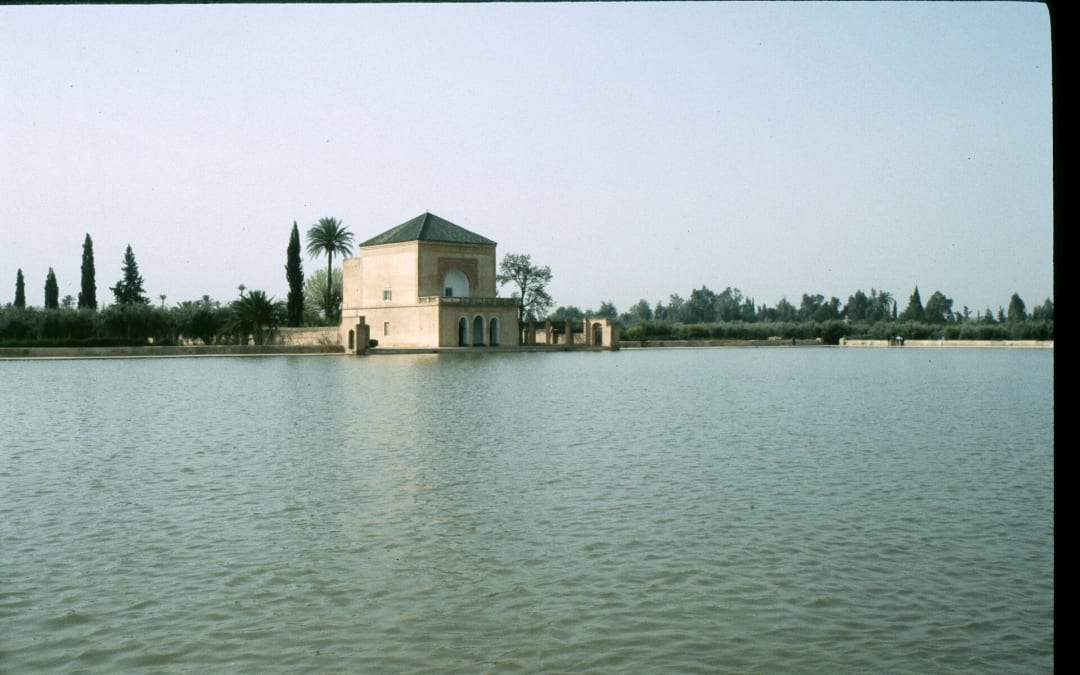
The Almohads also laid out large irrigated gardens, true orchards of olive and citrus trees around giant pools. The Menara pool, with its (later) pavilion and the Atlas as a backdrop, is one of the city’s postcard views; the Agdal gardens to the south are listed with the medina as a UNESCO World Heritage Site.
7. The Ben Youssef Madrasa (14th – 16th century)

Founded in the 14th century by the Marinids and entirely rebuilt by the Saadian sultan Abdallah al-Ghalib around 1565, the Ben Youssef Madrasa was one of the largest Koranic schools in the Maghreb. Around the courtyard and its pool, more than a hundred small cells housed the students. Zellige tiles, carved stucco, sculpted cedar wood: it is the perfect summary of Moroccan decorative arts.
8. El Badi Palace: “the Incomparable” (1578 – late 16th century)
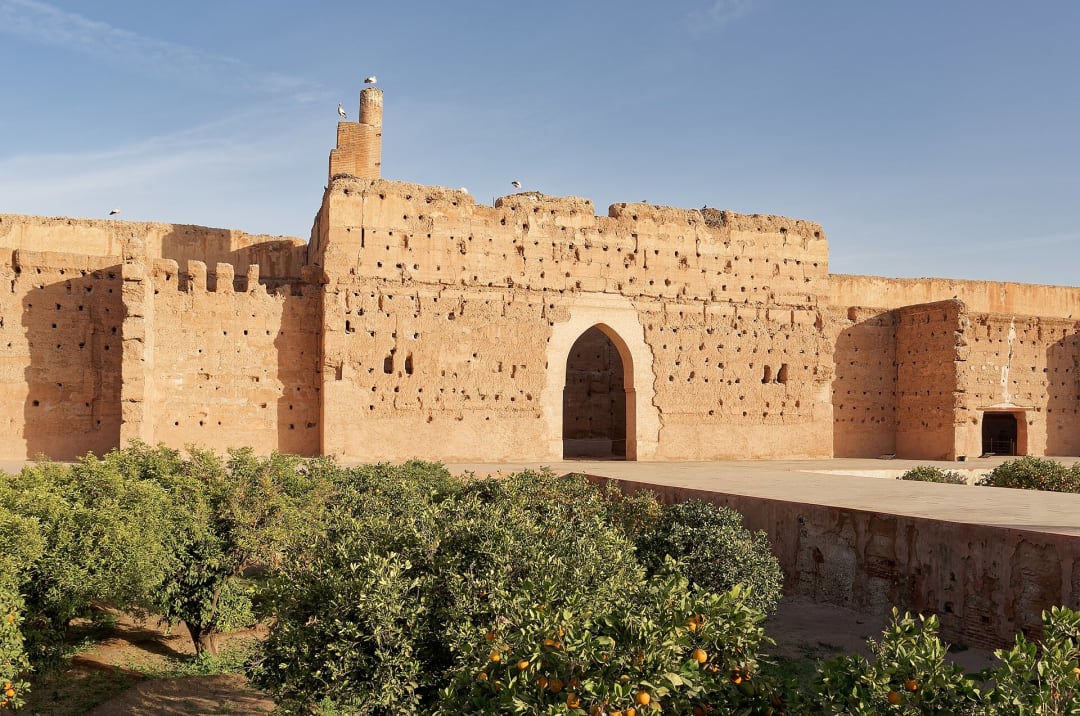
In 1578 the Saadian sultan Ahmad al-Mansur won the Battle of the Three Kings. With the ransoms and the gold of the Saharan trade, he built El Badi, “the Incomparable”: marble, onyx, gilded ceilings and huge pools. A century later, the Alaouite sultan Moulay Ismail had it dismantled to decorate his new capital, Meknes. What remains are gigantic walls, pools and orange trees, and the storks nesting on the ramparts.
9. The Saadian Tombs (16th – early 17th century)
Ahmad al-Mansur, who died in 1603, lies with his family in a necropolis of astonishing richness, including the famous Hall of the Twelve Columns in Carrara marble. The Alaouites walled up the entrance, and the tombs fell into oblivion until they were rediscovered in 1917. Arrive early: the queue to see the main hall can be long.
10. The Mellah and Bahia Palace (16th – 19th century)
Created in the mid-16th century next to the Kasbah, the Mellah was the Jewish quarter of Marrakech: you can visit the Lazama synagogue and the vast Jewish cemetery. Close by, the Bahia Palace, “the Brilliant”, built in the late 19th century by the grand viziers of the time, unfolds its courtyards, gardens and painted ceilings: it is the last great palace of the historic city.
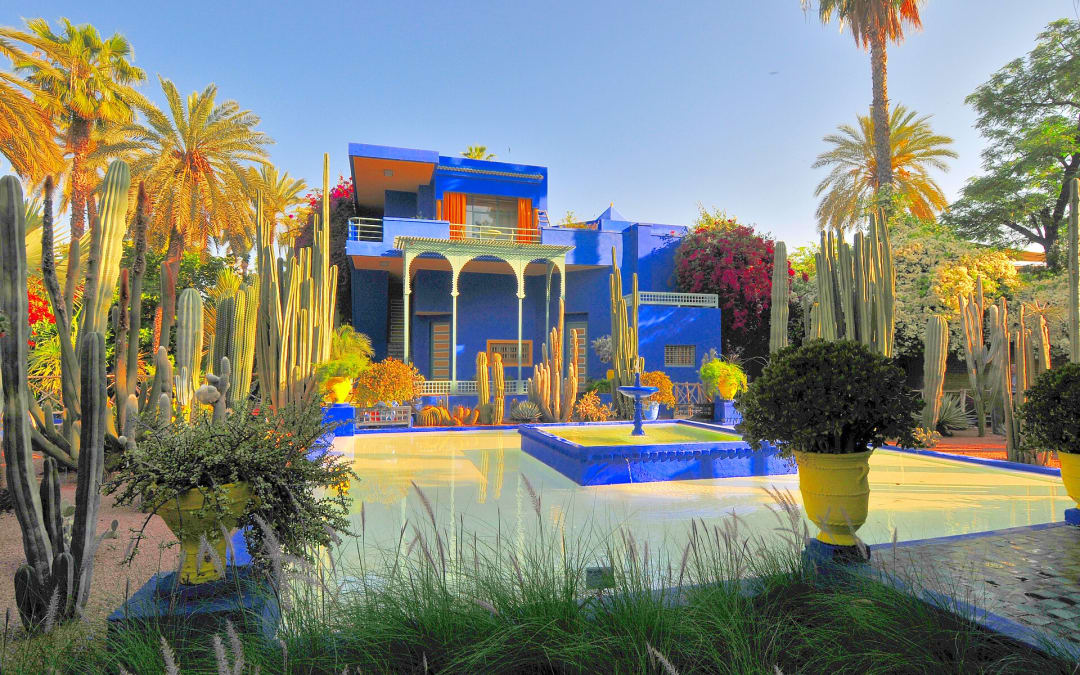
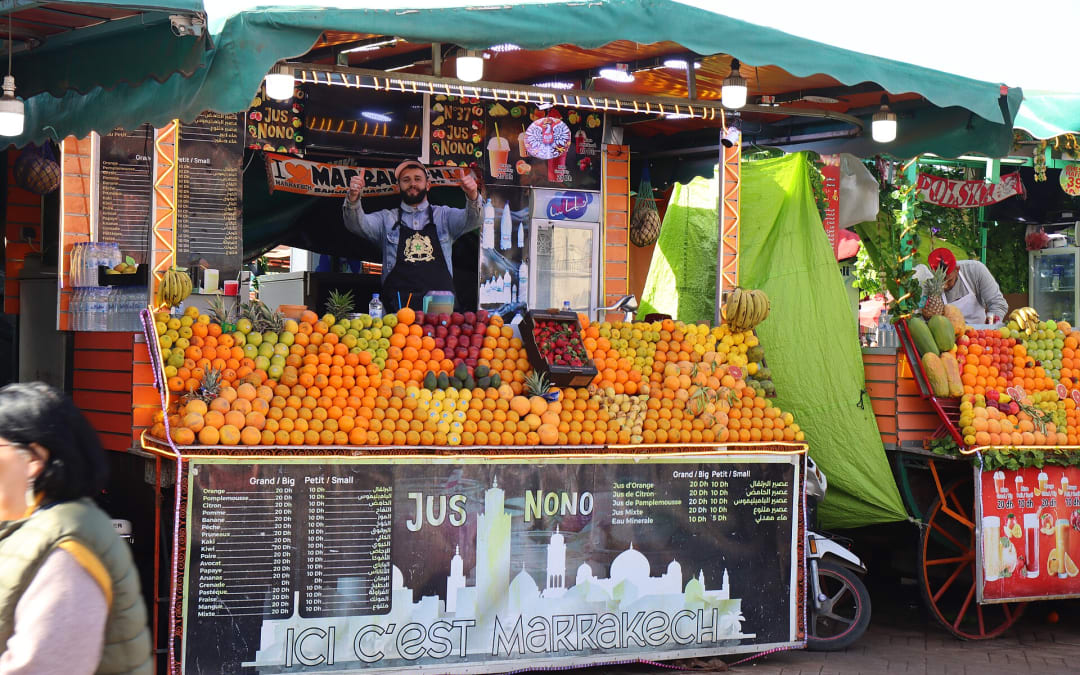
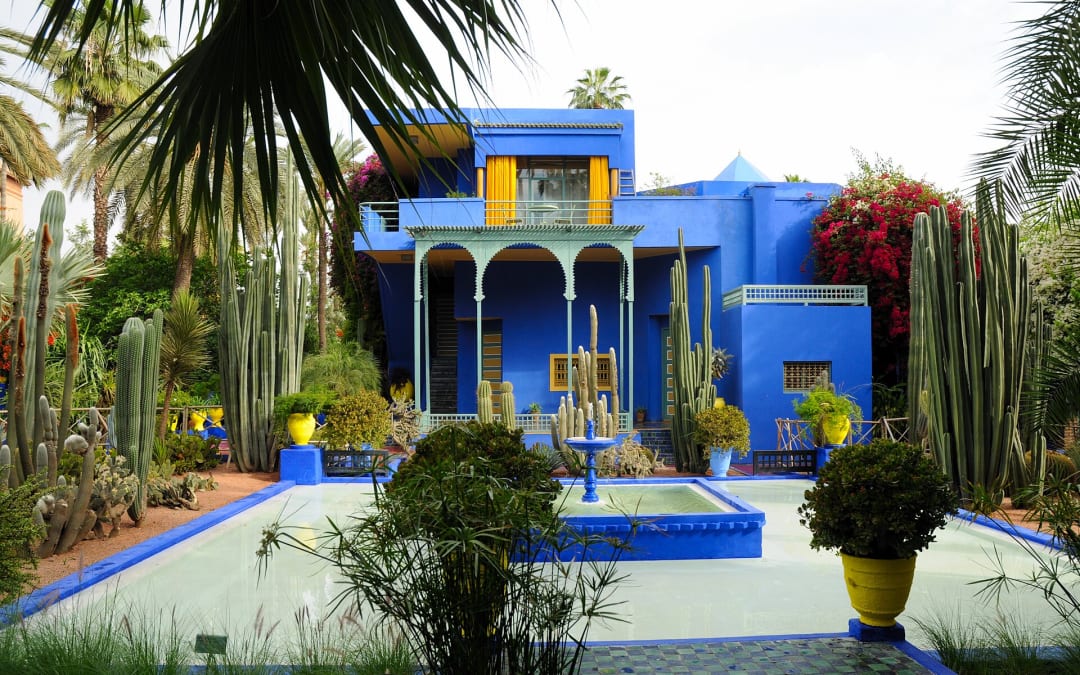
And the story goes on: Jemaa el-Fna square, proclaimed a Masterpiece of the Oral and Intangible Heritage of Humanity in 2001, and the Majorelle Garden, created by a French painter in the 1920s and 1930s, are now monuments in their own right. See our guides to Jemaa el-Fna square and the Majorelle Garden.
The walking route: a thousand years in two half-days
Morning 1, royal Marrakech: Koutoubia, Bab Agnaou, Kasbah Mosque, Saadian Tombs, El Badi Palace, the Mellah, Bahia Palace. About 3 km on foot.
Morning 2, scholarly Marrakech: Ben Youssef Madrasa, the Almoravid Koubba, then the souks and Jemaa el-Fna square at the end of the day.
With an official guide, the monuments take on a whole new dimension: book our Marrakech guided city tour, or read our guided medina route. And to trace the Almohads back to their roots, the trip to Asni and the Ouirgane Valley can be extended to the Nfis Valley, the cradle of the dynasty.
In short
Founding Almoravids, building Almohads, lavish Saadians, refined Alaouites: in ten monuments, Marrakech tells a thousand years of Moroccan history. To discover it without getting lost, contact us: airport transfer, guided tour and day trips to suit you.