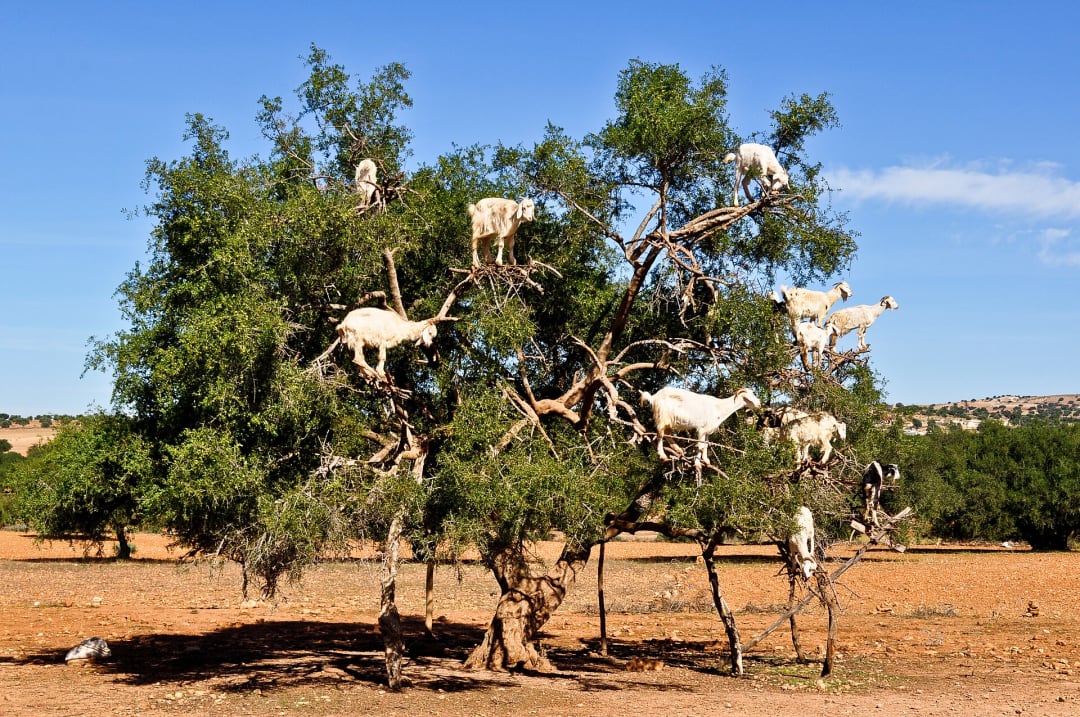
It is one of the most shared images of Morocco: goats perched in a tree, balancing on branches several metres above the ground. No, it is not photoshopped. But not everything is always as spontaneous as it looks. Where can you see goats in argan trees? Why do they climb? What lies behind some of the roadside photos? And what does it all have to do with argan oil? Here is the real guide, from drivers who make the Marrakech to Essaouira run several times a week.
The argan tree, unique in the world
The argan tree (*Argania spinosa*) grows naturally only in south-western Morocco, between Essaouira, Agadir, Taroudant and the Anti-Atlas. Thorny and gnarled, able to withstand drought thanks to very deep roots, it forms open forests where families have grazed their flocks and harvested the fruit for centuries. This forest, the arganeraie, was recognised as a UNESCO biosphere reserve in 1998, and the know-how linked to argan has been on the list of the intangible cultural heritage of humanity since 2014. The United Nations has even dedicated an international day to the argan tree, on 10 May.
Why do goats climb trees?
Simply to eat. In these arid landscapes, grass is scarce for much of the year, while the argan tree keeps its leaves and bears fleshy fruit that ripens in early summer. The small, agile local goats have learned to climb onto the low branches and then higher and higher, helped by their split hooves and their sense of balance. You see them mostly when the fruit is ripe, from late spring to autumn, and when the herder leads the flock into the argan forest.
The goats eat the pulp of the fruit and spit out or pass the very hard nut. In the past, some of the nuts were collected from these droppings to make oil: hence the legend that argan oil “goes through the goats”. Today, cooperatives work with fruit picked or gathered from the ground and then dried, which guarantees good-quality oil.
Where can you see goats in argan trees?
- On the road from Marrakech to Essaouira, especially in the last hour of the drive, as you enter the argan forest. It is the best-known spot.
- Between Essaouira and Agadir, on the coast road, where the argan forest runs almost down to the ocean. See our guide to the Agadir to Essaouira coastal road.
- In the Souss plain, around Taroudant and on the back roads inland from Agadir.
There is no guaranteed timetable: the goats are there when the herder is there. Mornings and late afternoons are often the best times.
The truth about some photos

Along the Essaouira road, you will probably see a tree full of goats right next to the tarmac, with a few cars parked and a man waiting for a coin for the photo. These scenes are often staged: the animals are placed there, sometimes on adapted branches, and stay perched much longer than they would on their own, in the full heat. Animal welfare organisations have raised concerns about these practices.
Our advice: prefer natural scenes, in the argan forest, at a distance from the flock, without feeding the animals. If you do stop at a “goat tree”, keep it short and decide freely whether to give anything: you owe nothing if you are just passing by. Your driver can often spot a flock that is genuinely climbing on its own, a little further from the road.
From tree to oil: visiting a cooperative

On the same road, dozens of women’s cooperatives produce argan oil and welcome visitors, often free of charge. The process is still largely done by hand:
- Drying the fruit in the sun.
- Removing the pulp to free the nut.
- Cracking the nut between two stones, a precise gesture that takes years of practice: it is the longest stage.
- Roasting the kernels for culinary oil, with its hazelnut taste; they stay raw for cosmetic oil.
- Pressing, with a millstone or a press, then letting the oil settle.
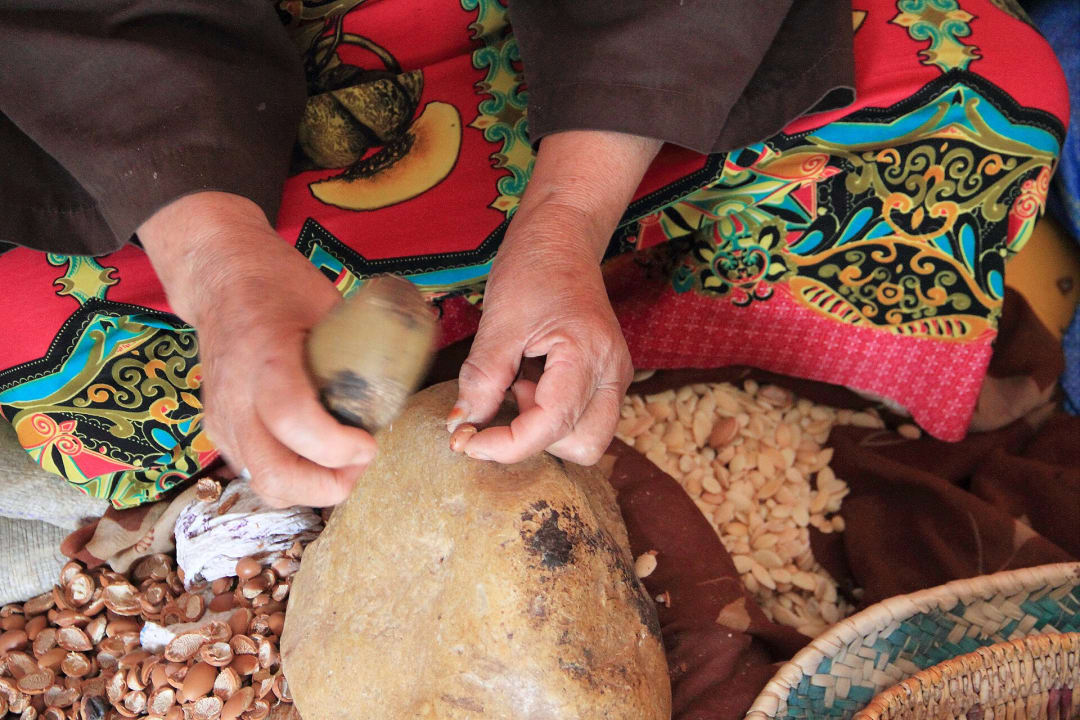
It takes several tens of kilos of fruit to make a single litre of oil, which explains its price. In the cooperatives you can also taste amlou, a spread of almonds, argan oil and honey: a treat we describe in what to eat in Marrakech.
How to recognise genuine argan oil
- Price: pure oil cannot be cheap. Beware of small bottles sold for a few dirhams by the roadside.
- Smell: culinary oil smells of roasted hazelnuts; cosmetic oil has a light smell, never rancid.
- Label: buy from a cooperative, with a label showing the composition, origin and date.
- Texture: cosmetic oil absorbs quickly, without a greasy film.
Planning the stop on your journey
The road from Marrakech to Essaouira takes about 2 h 45 to 3 hours. With a private Marrakech – Essaouira transfer or our Essaouira day trip from Marrakech, you can ask for a stop at a cooperative and a few minutes to watch the goats. Just mention it when you book: the break usually lasts 20 to 40 minutes. All the practical details of the route are in Marrakech to Essaouira: how to get there.
In short
Goats climb argan trees to eat their fruit and leaves, mostly from late spring to autumn. You can see them on the Essaouira road, on the coast towards Agadir and in the Souss. Prefer natural scenes to “staged” trees, and use the stop to visit an argan cooperative. For your journey, contact us.