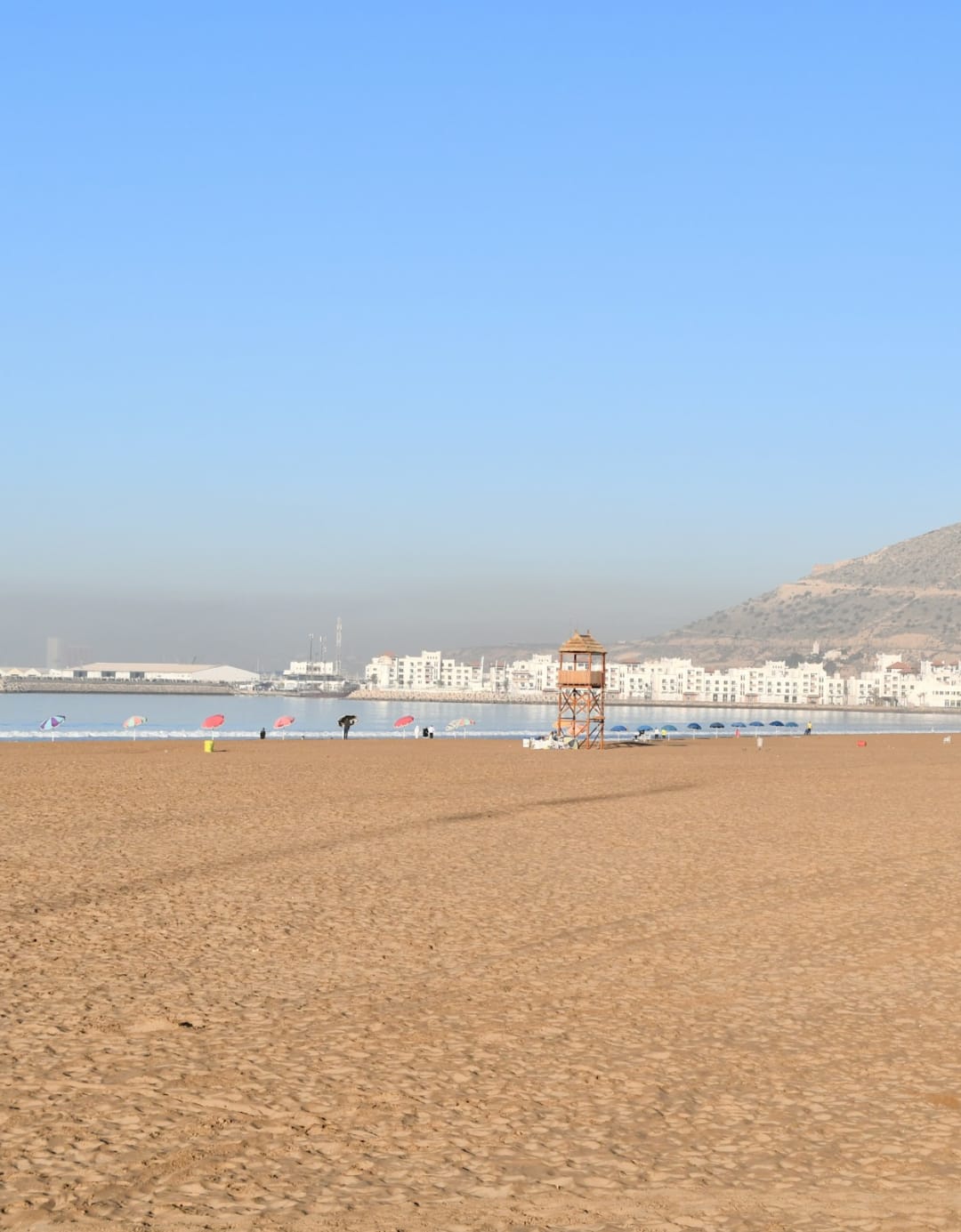

Less than an hour south of Agadir, Souss-Massa National Park protects one of the last wild refuges of a very rare bird, the northern bald ibis, as well as estuaries where flamingos, spoonbills and migrating birds stop. It is a nature outing little known to coastal holidaymakers: dunes, argan steppes, cliffs, river mouths and fishing villages. Here is what there is to see, how to organise the visit from Agadir or Taghazout and when to come to improve your chances of seeing the birds.
The park in a few words
Created in 1991, Souss-Massa National Park covers about 33,800 hectares along the Atlantic coast south of Agadir, between the mouths of the Souss and Massa rivers. It protects a coastline of dunes, cliffs and steppe, and above all two estuaries that are vital for birds. The Massa river mouth is a Ramsar site, a wetland of international importance.
The northern bald ibis, the park’s emblem
The northern bald ibis, with its black plumage shot with metallic sheen and its bare red head, has almost vanished from the wild. The Souss-Massa coast is home to most of the wild population left in the world: the birds nest on the coastal cliffs and feed in the nearby steppes and fields. Seeing them is never guaranteed, but with a local guide who knows their feeding areas the chances are real, especially early in the morning.
The two estuaries
The Souss river mouth
On Agadir’s doorstep, south of the city, the Souss estuary is an easy place for a first look: flamingos, spoonbills, herons, waders and gulls share the sandbanks and mudflats, especially at low tide and during migration.
The Massa river mouth
About 60 kilometres south of Agadir, near the village of Sidi Rbat, the Massa river forms a reed-fringed lagoon where you can see ducks, flamingos, spoonbills, birds of prey and many songbirds. An eco-guide kiosk near Sidi Binzarne helps you find a local guide. It is the heart of the park for birdwatchers.
A typical day from Agadir
| Time | Stop |
|---|---|
| 7.30 am | Leave Agadir or Taghazout |
| 8.00 am | Souss estuary, at low tide if possible |
| 9.30 am | Drive south through steppe and argan trees |
| 10.30 am | Massa river with an eco-guide, looking for the bald ibis |
| 1.00 pm | Fish lunch in Tifnit or a coastal village |
| 3.00 pm | Tifnit’s wild beach and fishermen’s huts |
| 5.00 pm | Back to Agadir |
When to come
- September to April: the best period, with migrating and wintering birds and pleasant temperatures.
- Spring: the bald ibis breeding season, with viewing possible at a distance from the breeding areas.
- Summer: fewer migrating birds, heat in the middle of the day; start early.
- Always early in the morning: birds are more active and the light is better for photography.
What to bring
- Binoculars, essential, and a telephoto lens if you take photos.
- Discreet clothes in neutral colours.
- Good shoes for walking on sand and paths.
- Water, a hat and sunscreen: there is little shade.
- Cash for the eco-guide and lunch.
Combining it with the southern beaches
The outing combines very well with Tifnit, its fishing village and wild beach, or, for a longer day, with the coves of Mirleft and the Legzira arches. Our article on the best beaches around Agadir covers these stops. For other nature outings, see also Paradise Valley and our guide to day trips around Agadir and Taghazout.
The park’s other birds and landscapes
The bald ibis is not the only reason to come. In the estuaries and lagoons you can see, depending on the season, flamingos, spoonbills, herons, egrets, many waders and ducks. Birds of prey glide over the cliffs and steppes. Between the two river mouths the landscape alternates fixed dunes, ochre cliffs, steppes of argan trees and euphorbias, and small fishing villages. Even if you are not a birdwatcher, the day offers beautiful wild coastal scenery.
Watching responsibly
- Stay on the tracks and marked paths, and park in the designated places.
- Keep your distance from the birds, especially in the breeding season.
- Leave no rubbish: estuaries are fragile environments.
- Use the local eco-guides: they know the best viewing spots and their work supports the park’s villages.
- Avoid drones, which are banned in many protected areas.
With children
The outing is a big hit with children curious about nature, as long as the pace stays light: an hour of watching at the estuary, a short walk, then lunch and the beach at Tifnit. Lend them binoculars and a small bird guide: looking for the ibis then becomes a real treasure hunt.
Booking
The Souss-Massa day is done in a private vehicle with a driver, from your hotel in Agadir, Taghazout or Tamraght, with an early start to make the most of the best viewing hours: ask for your programme from the contact page. If you have just arrived, the Agadir airport transfer takes you to your accommodation, and the Tafraout trip shows you the Anti-Atlas in a day.