
A wheelchair, a walking stick, a knee operated on last year or simply legs that tire quickly: many travellers give up on Morocco, picturing impossible lanes and steps everywhere. That is a shame, because with good preparation, Marrakech, Agadir and Essaouira can be enjoyed very well with reduced mobility. The key comes down to three things: transport, accommodation and pace. Here is an honest guide, based on our experience as a transport company, to what is easy, what takes organising, and what is best avoided.
What to know before you go
Morocco is making progress on accessibility, but it remains uneven. Airports, large hotels and modern districts are generally accessible; the historic medinas, with their cobbles, steps and narrow lanes, much less so. Pavements can be high or cluttered. None of this rules out the trip: you simply need to choose the right places and the right way of getting around.
Arriving at the airport
Marrakech Menara airport, like those of Agadir and Casablanca, offers assistance for passengers with reduced mobility: a wheelchair and help through passport control and baggage reclaim. Request it from your airline at least 48 hours before the flight. Outside, your driver waits in the hall with a sign bearing your name and takes over: luggage, folded wheelchair, getting you settled in the vehicle.
Our vehicles: what is possible, openly
Our vehicles are standard passenger vehicles, with no ramp or lift. In practice:
| Situation | Possible? | How |
|---|---|---|
| Traveller walking with a stick or crutches | Yes, easily | Front seat or sliding door, help getting in |
| Folding manual wheelchair, traveller able to take a few steps | Yes | The wheelchair travels folded in the boot |
| Traveller who needs help transferring from wheelchair to seat | Yes, with a companion | The driver helps, at your pace and following your instructions |
| Heavy electric wheelchair | To be checked | Send us its dimensions and weight before booking |
| Travelling without leaving the wheelchair | Not with our vehicles | You need an adapted vehicle with a ramp |
The Mercedes Vito is often the most practical: a wide sliding door, a flat floor and a large boot for a wheelchair and luggage. The premium SUV suits travellers who prefer a higher seat, which is easier to get into and out of. Just tell us what you need: we will give you an honest answer about what can be done.
Where to stay: the most important choice
- In Marrakech, a hotel in Hivernage, Agdal or the Palmeraie lets you drive right up to the door, with a lift and adapted rooms. Medina riads are beautiful but often difficult: steps, sunken courtyards, upstairs bedrooms. If you have your heart set on a riad, choose one close to a car access point, with a ground-floor room. Our article on getting to your riad in the medina details the distances.
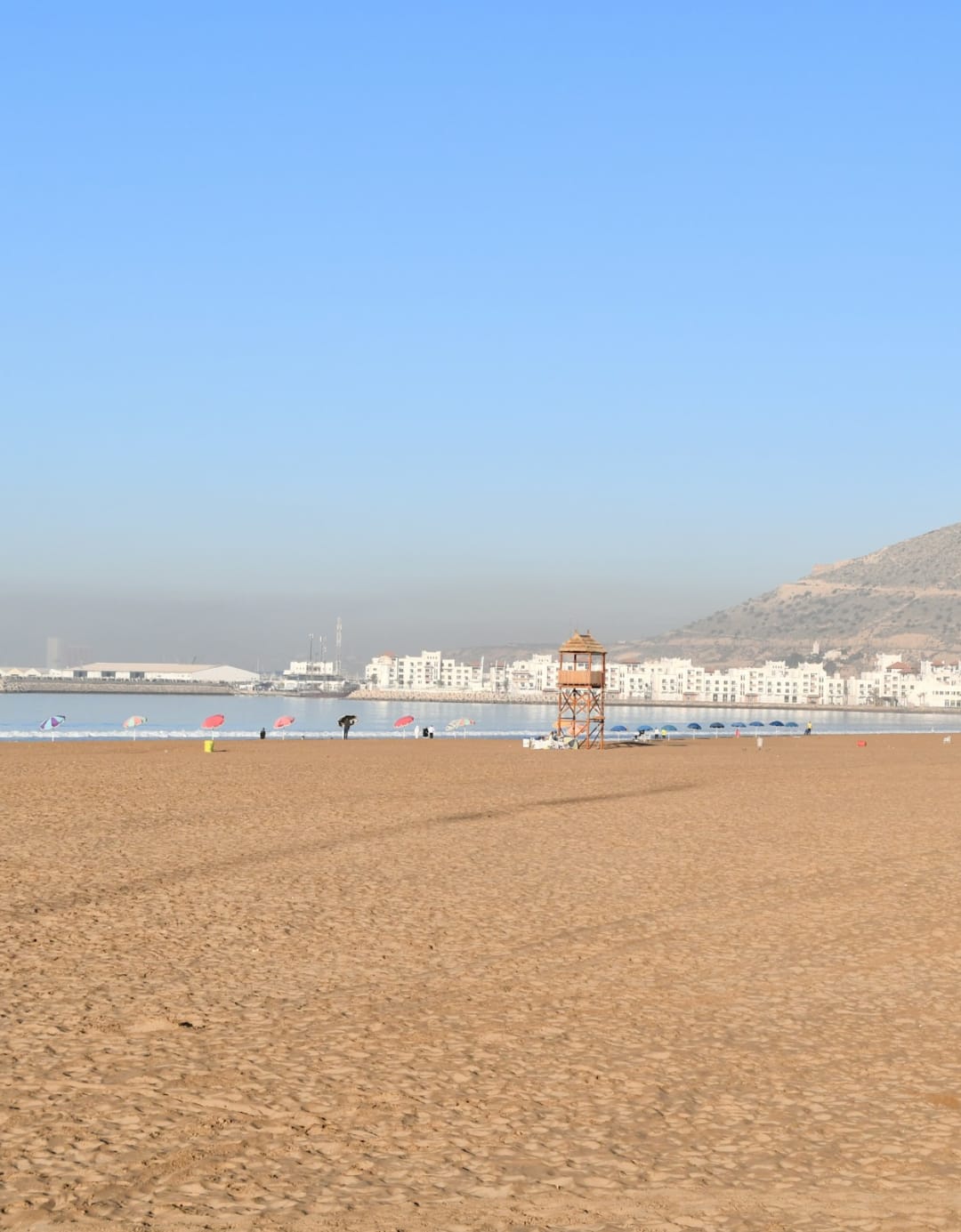
- In Agadir, most of the large seafront hotels are modern, on one level or equipped with lifts. It is the easiest destination in Morocco for reduced mobility.
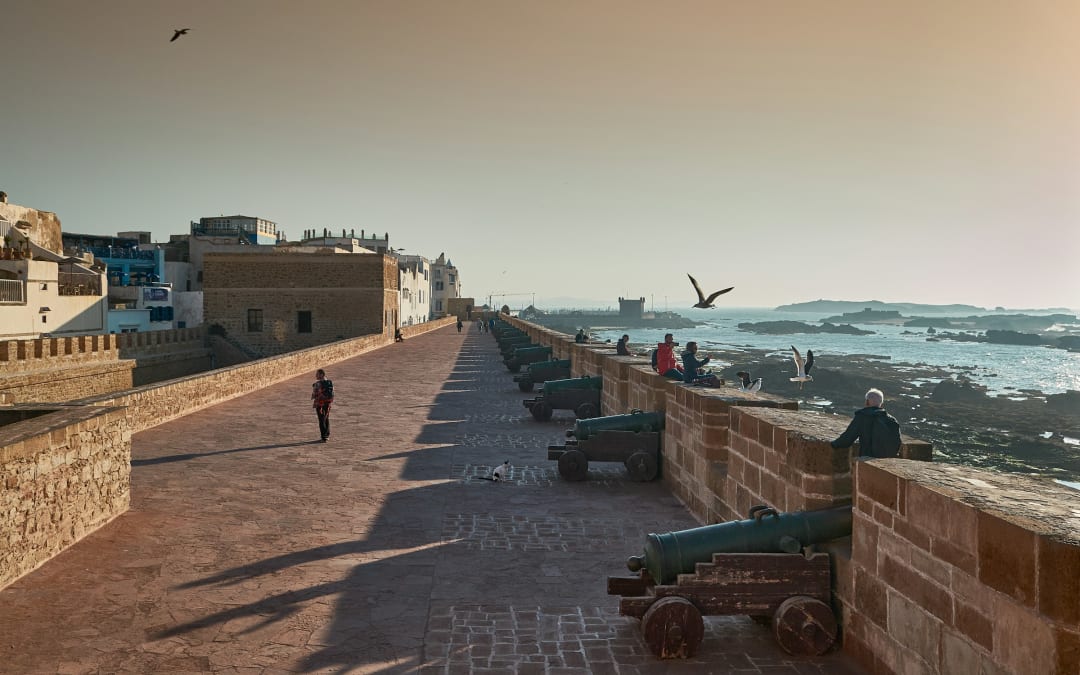
- In Essaouira, hotels outside the ramparts, along the beach, are more accessible than the riads inside the medina.
The most accessible places
- Agadir and its seafront promenade, wide, flat and several kilometres long, lined with cafés and restaurants.
- The Majorelle garden and the Menara garden in Marrakech, with mostly level paths.
- Jemaa el-Fna square in the late afternoon, watched from an accessible terrace rather than from the middle of the crowd.
- The Agafay desert, 45 minutes from Marrakech, where some camps have tents on one level: a lovely alternative to the long drive to Merzouga.
- The Atlas road to the Ourika valley, enjoyed mostly from the car, with stops at viewpoints and lunch by the river.
Pace: less driving, more breaks
Long journeys are more tiring when moving is difficult. We recommend stages of three hours at most, regular breaks to stretch, and days without driving between two transfers. For example, Marrakech to Essaouira (about 2 h 45) or Marrakech to Agadir (about 3 hours) work very well in one stage, with a stop halfway. Our article on long drives in Morocco without the fatigue gathers all our comfort tips.
A sample week
- Days 1 to 3: Marrakech, a hotel with a lift in Hivernage, the gardens, the medina explored along its main streets, an evening in Agafay.
- Day 4: transfer to Agadir, with a break halfway.
- Days 5 to 7: Agadir, the seafront promenade, the harbour, a drive up to the Agadir Oufella kasbah for the view, then a flight home from Agadir or a return to Marrakech.
Practical questions
Can the driver help lift the traveller? He gladly helps with getting in and transferring, carefully and following your instructions; a companion is still recommended. Can we travel with an electric wheelchair? Often yes, if it can be dismantled or fits in the boot: send us its dimensions. Are pharmacies easy to find? Yes, in every town, and the drivers know the late-night pharmacies.
Book transport that fits your needs
The Marrakech airport transfer and the Agadir airport transfer can be booked with your specific needs noted in the form: wheelchair, help with transfers, front seat. To link the two cities, the private transfer from Marrakech to Agadir is one comfortable stage. All our fares are on the private taxi in Marrakech page, and you can describe your situation to us from the contact page: we will tell you frankly what we can do, and how to make your trip as easy as possible.